A Monitoring Upgrade Is Not a Replacement Project
There’s no reason to upgrade a public-safety radio system just to get a better view of what’s going on. There are many other reasons to monitor an existing public-safety radio system. All of your antennas, cable, and amplifier equipment should be inspected, tested and evaluated based upon their condition, suitability and how well they’re performing.
Just because you can’t see some of these components doesn’t mean everything has gone bad. Owners need to make decisions on balancing modernization with maintenance. CISA has developed lifecycle planning guidelines (for emergency communications) as an on-going investment that will require both maintenance and funding during the entire life of the investment. Applying this same philosophy to an existing Distributed Antenna System (or DAS), will provide a very logical way to make a decision: Identify what capability is lacking before determining what equipment must be changed.
TX RX Monitoring Works Alongside Existing Infrastructure
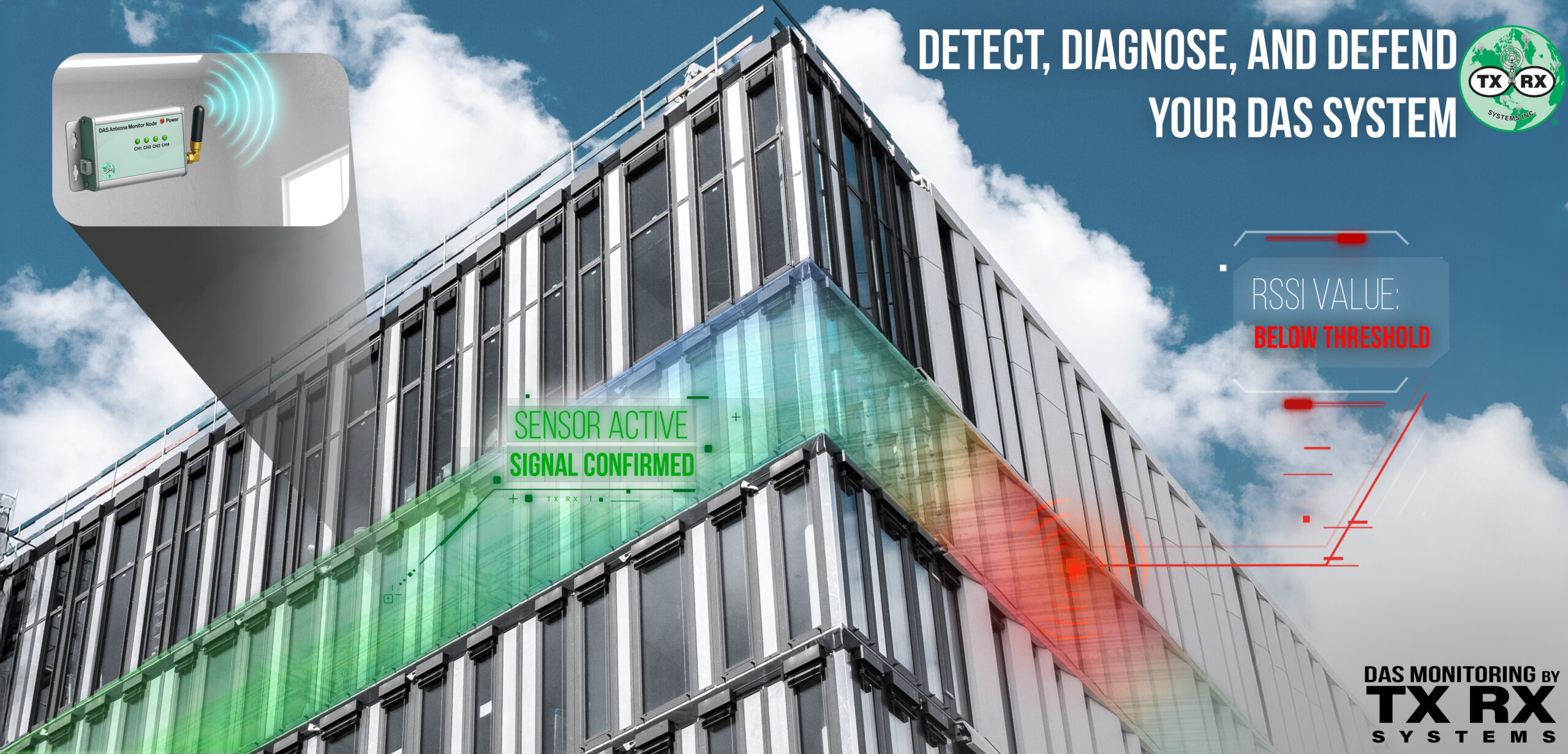
The TX RX Systems DAS Monitoring System is designed to operate alongside existing DAS installations. Its capabilities include monitoring up to 256 separate antenna locations, live signal level updates, alarm logs, and 3D building mapping. Monitoring information can be accessed without entering the building.
For owners of an otherwise suitable public safety DAS, that creates an alternative to a complete rebuild. The immediate objective can be better oversight of the installed system, with replacement decisions reserved for equipment that testing or engineering review identifies as unsuitable. The proposed monitoring arrangement still needs to be confirmed for the actual installation.
Practical Uses in Occupied Buildings
Maintenance coordination within a large office building. If a technician observes a change in the received signal strength at a particular monitored antenna location, he/she will know exactly where to start looking for the source of the change. The technician will still perform a root-cause analysis to find out why the signal strength has decreased. However, the service request will now indicate the location(s) that were affected by the decrease in signal strength, along with any observed changes.
Managing renovations within a leased space. Members of the project team can take notes and document relevant changes in signal levels before construction begins. They can note when the ceiling tiles are removed and/or when access to various pieces of equipment is provided. After completion of the renovation, members of the project team can document changes relative to the previous documentation. While a read-out from one of the monitored antenna locations will show a change in signal strength due to the renovation, it will not prove that radio coverage exists throughout all adjacent rooms.
In either case mentioned above, formal testing will always be necessary to ensure compliance with applicable codes and regulations. For example, Washington State currently mandates annual inspections/testing of the radio coverage provided inside buildings to emergency responders, along with testing after structural changes occur that could impact the original field performance results. Other jurisdictions may mandate different testing frequencies. The monitoring data can assist in identifying potential issues related to the testing process; however, it cannot eliminate the requirement for performing the tests.
A Retrofit Still Starts With the Existing System
Regardless of the method used to install the monitoring system, the first step should be to gather and review all relevant documents including; a list of all equipment currently being utilized; a map showing the locations of all antennas; a summary of all known service-related problems/deficiencies; and any records documenting past acceptance testing. These documents enable both the owner and integrator to differentiate between an informational void versus an actual deficiency in performance of the existing radio system. A failed test result cannot be assumed to be fixed simply because a monitoring interface was installed.
Project planning should define the locations to be monitored, required hardware, installation access, power arrangements, and the intended method of viewing results. It should also assign responsibility for reviewing information and arranging service. Remote visibility has limited operational value when nobody is responsible for responding.
Approvals depend on the work and jurisdiction. Washington’s rules, for example, distinguish maintenance from modifications that require a construction permit. That distinction illustrates why an addition to an existing system still needs a defined scope and coordination with the applicable authority having jurisdiction.
Monitoring Supports Maintenance, Not Automatic Certification
Having a fully functional monitoring dashboard and knowing that your radio system is actually working represent two distinctly different things. Monitoring observations can aid in making informed maintenance decisions. However, they should never be used as evidence of successfully communicating with all test points.
Booster operation has separate regulatory obligations. Under FCC rules for signal boosters, a building owner operating a booster without its own applicable radio license must obtain the relevant licensee consent. The rules also address harmful interference and the engineering controls needed to avoid it. A monitoring retrofit does not replace those obligations or establish that a booster is operating acceptably.
Engineering and Field Support Complete the Upgrade
TX RX Systems combines monitoring with RF engineering, testing, and field services. Its documented capabilities include signal level mapping, interference investigation, spectrum and noise analysis, and reports containing findings and recommendations. The company also provides RF manufacturing services in the United States.
That combination gives an owner a practical route from an observed issue to an engineering evaluation. Where additional investigation is needed, the service scope can focus on the affected system and measured conditions. The monitoring product supplies information; qualified assessment determines whether the appropriate response is repair, adjustment, further testing, or replacement.
This is also relevant to public safety interoperability. A monitoring display does not create interoperability between radio systems. Its role is to help maintain the indoor RF infrastructure on which supported communications depend, while the responsible agencies and integrators manage system compatibility and operating requirements.
Preserve Useful Equipment and Fund the Actual Need
The budgeting principle is to separate retaining equipment from neglecting it. Lifecycle planning provides a framework for continued support, maintenance, and investment. A monitoring project should therefore include its own installation, training, and support needs rather than be treated as a cost free extension of the existing DAS.
It is still possible that some parts of your current radio system need to be replaced if identified as unsuitable. Retaining usable infrastructure combined with improved oversight provides a different decision-making process. TX RX Systems DAS Monitoring provides building owners with a means to achieve that targeted approach: Add valuable visibility; Maintain accountability for maintenance responsibilities; Use monitoring data to determine what subsequent work must be performed based on condition of the system versus assumptions that modernization requires starting from scratch.