Alarm Compliancy Is Not Equivalent To RF Visibility.
A DAS/ERCES system’s ability to continue to operate under changing environmental conditions (building layout, tenants usage, utilities, batteries, etc.), during the lifecycle of the system, is an expectation. The 2024 International Fire Code states that all ERCES systems installed inside a building shall be supervised by either a listed fire alarm control panel or at a minimum an audible signal located at a continuously attended station. The above mentioned supervising conditions are; loss of normal AC power, battery charger failure, malfunction of the signal source, active rf emitting device failure, low battery capacity when the battery has been discharged by 70 percent of its 12 hour operating life, critical component failure, communications link failure and oscillation of active rf emitting devices.
A system can have both “normal” power and “active” rf status but still experience localized coverage loss due to increased loss in a particular antenna branch, altered connector conditions, modified ceiling builds out which have altered the path loss, or relocated serving antennas which are no longer within the same rf environment as measured at acceptance. The maintenance gap is not due to a lack of alarms. The maintenance gap is due to there being little to no location specific rf information between formally scheduled test events.
Loss Of Coverage Can Start As a Single Locally Unfavorable RF Condition.
The 2024 International Fire Code defines emergency responder coverage as a measured performance condition. Acceptable in-building coverage is determined based upon signal strength measurements taken across the entire building. Ninety five percent of all areas of the building and ninety nine percent of the critical areas must meet the applicable signal strength criteria. The code also considers performance in terms of delivered audio quality, bit error rate and/or signal-to-interference plus noise ratio depending on the type of radio technology utilized by public safety operations.
As noted above, defining acceptable performance is important. Failures in a DAS/ERCES system rarely begin with a total loss of the system. They typically start as a locally unfavorable rf condition. One single antenna location may lose some or all of its previously measured signal strength. An individual antenna branch may add new attenuations. A newly renovated area may alter how signals propagate around an elevator lobby, stairwell, mechanical room or storage area. These local changes will typically go undetected through basic supervisory monitoring until a complaint, annual test or incident occurs and brings the degraded coverage to light.
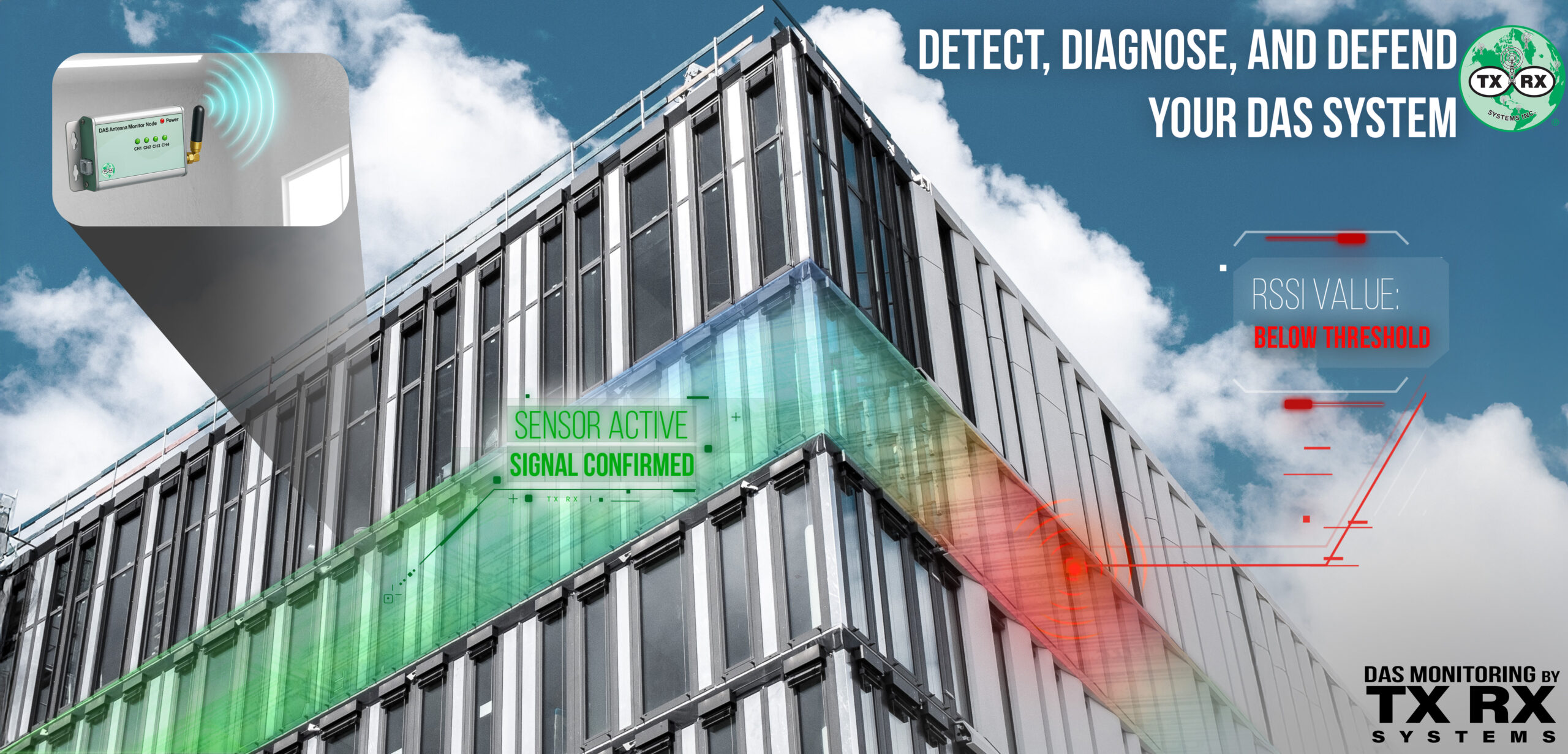
TX RX Systems provides a solution to the blind spot described above by using a DAS Monitoring System designed specifically for in-buildings public safety signal monitoring. According to TX RX Systems, their DAS Monitoring System is able to monitor up to 256 separate antenna locations and provide live signal level updates, full building coverage maps, alarms logs and 3d mapping of buildings. The monitoring data provided can be viewed remotely and outside of the building and can be done in conjunction with an already installed DAS system.
The primary advantage of utilizing the TX RX System’s DAS Monitoring System is that it changes the approach to determining the cause of problems experienced with a DAS system. Rather than only knowing that the system has entered into an alarm state, the building owner/operator, service provider and/or public safety stakeholder can correlate signal behavior with a physical location. This changes the first diagnostic question from simply determining if the system is functioning to identifying where coverage has diminished and when the diminishment occurred.
Service Teams Will Be Able To Address Issues More Quickly & Effectively
Field service personnel performing repairs/maintenance on public safety radios inside commercial/institutional buildings often face constraints related to access windows, coordinating with tenants, scheduling of life safety systems, and requirements/restrictions placed by authorities having jurisdiction. Providing field service personnel with location-specific signal history prior to arriving at a job site allows them to arrive with a measured beginning point rather than conducting a general building-wide survey. Additionally, reviewing alarm history, identifying specific locations where antennas are located, and viewing real-time signal levels will allow service personnel to identify potential areas that need to be inspected prior to connecting tool cables to initial cables.
Although grid testing, gain verification, battery testing, and manufacturer specification checks are required by code and local practice; the TX RX Systems DAS Monitoring System will give field service teams a more structured method to prioritize these tasks. A documented decrease in signal strength at a known antenna location indicates possible issues related to a defined branch of the system. A stable antenna group with only one area of localized degradation indicates possible issues related to a local condition. A decrease in signal strength building wide indicates possible issues related to donor signals, gain, power or active components.
FCC Signal Booster Rules Place Responsibility On Licensee Regarding Harmful Interference
Indoor DAS monitoring also correlates with federal regulations regarding public safety signal boosters. Under section 90.219 of title 47 cfr part 90 — private land mobile radio services — harmful interference from signal boosters must be corrected by the responsible party (licensee). Further under this section the FCC states that signal boosters are intended to improve weak signal areas do not extend licensed systems beyond their original design parameters.
Additionally under this section the FCC states that good engineering practices should be followed when radiating intermodulation products and noise. Also, if signal booster deployment results in harmful interference the FCC may require additional attenuation or filtering to correct the issue.
Therefore, ongoing behavior of a system post acceptance is important. Monitoring does not eliminate certified equipment, qualified installation, licensee approval or spectrum analysis. However, monitoring supports maintaining records showing when rf levels changed, where they changed, and whether a change was caused by a local issue or a broader systemic issue.
In addition to requiring ERCES maintenance and annual testing, The 2024 International Fire Code also requires testing whenever structural changes could materially change original field performance test results. annual testing and acceptance testing remain the primary methods for demonstrating compliance. The continued collection of signal history between tests adds data continuity between test Dates.
With many modern office buildings experiencing constant construction activity (tenant improvements, interior wall construction, equipment installation/removal, rooftop work, fire alarm servicing/battery replacement/network upgrades) there is a great deal of uncertainty as to what impact any given event has on overall coverage. Collecting location-based signal history allows service teams to distinguish between gradually decreasing signal strengths and sudden decreases tied to specific events. Reducing guesswork & enhancing the quality of the maintenance record presented to owners/servicers/AHJs is the goal.
Positioning Within DAS/Monitoring Practicality
TX RX Systems views DAS monitoring as a visibility problem for servicing rather than a replacement for rf engineering judgment. As a US Manufacturer supplying public safety rf infrastructure equipment in north America, TX RX Systems is situated near the practical limitations affecting maintenance of in-building coverage. The monitoring capability extends that role by enabling owners and field service teams to see real-time signal levels and alarm history associated with each antenna location along with coverage maps.
While TX RX Systems does not claim that monitoring will prevent every failure; the benefit of earlier evidence will allow technicians better insight prior to leaving the shop prior to arriving at jobsite; allow stakeholders better understanding of areas impacted by coverage concerns; and provide public safety communications managers better defensibility in understanding whether coverage concerns are localized, systemic or related to recent building changes.
Operational Result for Indoor Public Safety Coverage
Public safety radio coverage inside commercial/institutional buildings is now evaluated based on continuous readiness as well as installation performance. Fire alarm supervisory confirmation indicates defined trouble conditions. Annual testing demonstrates compliance at required times. Location-based rf monitoring occupies the operational area between these two points.
For field service teams this translates to fewer blind searches and more focused troubleshooting techniques. For property owners this enables a clearer documentation trail regarding system behavior. For public safety organizations and licensees this equates to greater visibility into in-building systems which interface with licensed land mobile radio networks. Ultimately this equates to an approach towards maintaining DAS systems based on measurable rf behaviors versus alarm conditions alone.